Screenbound blends split-focus platforming with layered puzzle design
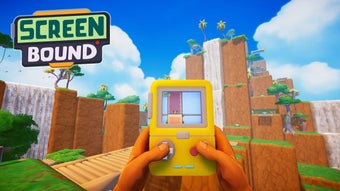
Screenbound, from Crescent Moon Games, casts the player into a fractured reality where recovering a missing mother drives the journey through dual-dimensional puzzles. The game requires simultaneous control of a 3D first-person avatar and a mirrored 2D side-scroller on an in-game handheld, using both views to solve environmental challenges and face cross-dimensional foes. Key systems include a 2D-to-3D level editor and environmental storytelling. It targets puzzle-platform fans seeking experimental spatial challenges.
A narrative premise that forces choices to carry weight
The opening places you directly in the story-world: after finding the mysterious handheld device, reality splits and every decision affects two linked playfields. So, movement and timing become narrative tools because progress toward the protagonist's missing mother depends on navigating interconnected levels and uncovering environmental secrets. The structure makes exploration consequential, with secrets and level layout used as plot beats rather than decorative touches.
The mechanics require constant cross-referencing between perspectives
The core loop asks you to monitor both planes at once: mirrored movement ties the 3D first-person view to a 2D side-scroller, and puzzles require information transfer across those planes. Quantum puzzles reward switching focus and reading how an action in one view changes the other. A playable Steam demo exists to test this simultaneous control before committing to longer sessions, which helps judge the cognitive demand.
Visual contrast and level design encode information across layers
The presentation mixes stylized 3D environments with authentic 2D pixel art, so visual language carries gameplay meaning; an object visible in one plane can signal a solution in the other. Environmental storytelling hides familial clues across interconnected stages, encouraging close inspection rather than combat-first play. The aesthetic pairing also clarifies which elements belong to each plane, reducing accidental confusion during tense sequences.
Creation tools and structure support extended returns
The built-in editor translates player-drawn 2D designs into playable 3D levels, which creates reasons to revisit the app beyond the campaign. The cross-dimensional combat and puzzles produce replay incentives when players test alternative designs or challenge themselves to faster clears. Additional appeal comes from the game's experimental framing, which rewards players who enjoy solving spatial reasoning problems by exploring component interactions.
A focused, experimental choice that rewards patient players
The app suits players who enjoy concentrated spatial puzzles and inventiveness, supported by an indie studio with a background in adventure and RPG titles. Early interest is substantial, reflected in the Steam demo uptake and broad social visibility, which underscores the concept's appeal. Some players may find the attention demands steep, so expect a deliberate, concentrated experience rather than casual pick-up play.